How to Choose a Warehouse Staffing Agency (2026)
Quick take. When you search for a warehouse staffing agency near me, nine criteria decide the outcome, and five of them carry most of the weight: real fill speed measured as a median rather than a best week, screening depth you can inspect, a safety record the agency can actually speak to, a no-show and backfill policy in writing, and proof they carry workers compensation and unemployment as the employer of record. Everything else is sales. We are FIS Recruitment. We staff pickers, packers, forklift and reach truck operators, material handlers, dock workers, inventory associates, and warehouse leads across Allentown, Bethlehem, Easton, Hazleton, the I-78 corridor, and Long Island, and most clients see a qualified slate within 24 to 72 hours after intake. Call 800.248.8687.
Why the Lehigh Valley makes this a harder choice than it looks
The Lehigh Valley is a genuine warehouse and distribution hub, not a market with a few sheds, which means the agencies here are all recruiting from the same labor pool and the same worker is frequently on three benches at once. Lehigh Valley Economic Development Corporation reported in January 2026 that nearly 74,000 people in the region now work in making and moving goods, more than any other sector, and that the number has grown 70.9 percent since 2010 against 23.2 percent nationally.
Two more numbers set the context. The Bureau of Labor Statistics put the Allentown, Bethlehem, Easton PA-NJ metro unemployment rate at 4.1 percent in June 2026, preliminary, on a labor force of about 469,200. And BLS Occupational Employment and Wage Statistics for May 2025 show how concentrated the work is: industrial truck and tractor operators in this metro carry a location quotient of 3.18, meaning the occupation is roughly three times as concentrated here as nationally, with laborers and freight, stock, and material movers at 2.07. Space is not the binding constraint it was. LVEDC's Q1 2026 commercial real estate report, published in June 2026, put the industrial vacancy rate at 9.3 percent, 4.8 percent for buildings under 100,000 square feet and 10.9 percent for larger facilities. People are the constraint.
The Long Island side runs on different economics, which is why you cannot compare bill rates across the two markets. The New York State Department of Labor sets the Long Island and Westchester minimum wage at $17.00 per hour as of January 1, 2026, while the Pennsylvania Department of Labor and Industry confirms Pennsylvania's minimum wage is still $7.25 per hour. Same agency, same service, structurally different rate floors.
The nine criteria that actually decide it
Nine things separate an agency that will cover your shifts from one that will apologize about them. Work through them in order, and ask for evidence rather than assurance on each.
1. Fill speed. Ask for their median time to first qualified slate on your role type, not their best week. Then ask what percentage of requisitions hit it last quarter. An agency that measures itself can answer in under a minute.
2. Screening depth. Ask what is actually checked: work history verification, references, background and drug screening where lawful, documented evidence of forklift certification and evaluation, and comprehension of safety instructions in the language the worker actually uses. Ask to see a sample screening record with the personal details removed.
3. Safety record. Ask whether they train before day one, whether anyone from the agency has walked your floor, and whether they can speak to their recordable incident rate on placed workers. An agency that has never asked to see your dock is not managing your safety exposure.
4. Shift coverage. Nights, weekends, split shifts, and holiday peaks are where agencies separate. Ask which shifts they have actually filled in your county in the last 90 days.
5. Backfill policy. Get the no-show policy in writing: how fast a replacement arrives, who absorbs the cost of the gap, and what happens on a Sunday night. A verbal promise here is worth nothing at 5am.
6. Turnover. Ask for retention on the workers they have placed, not industry averages. First 30 day retention on your role type is the number that predicts your next quarter.
7. Workers comp. The agency must be the employer of record and must carry the coverage. The Pennsylvania Department of Labor and Industry states that workers compensation coverage is mandatory for most employers under Pennsylvania law, and that employers without it may be subject to lawsuits by employees and to criminal prosecution. A narrow set of exemptions exists, so ask the agency to show coverage rather than assume it. The New York State Workers' Compensation Board states that an employer with employees working in New York may be required to provide workers compensation, disability benefits, and Paid Family Leave coverage. Ask for current certificates, and ask who carries unemployment.
8. Injury handling. Agree in advance who reports, who investigates, who pays, and how fast you are told. Then ask what happened the last time a placed worker was injured, and listen for whether they have a process or a story.
9. Local bench. Ask where they recruit. An agency that drives workers 50 minutes to fill your first shift will lose them in week two, and you will be back in the same conversation with a worse start date.
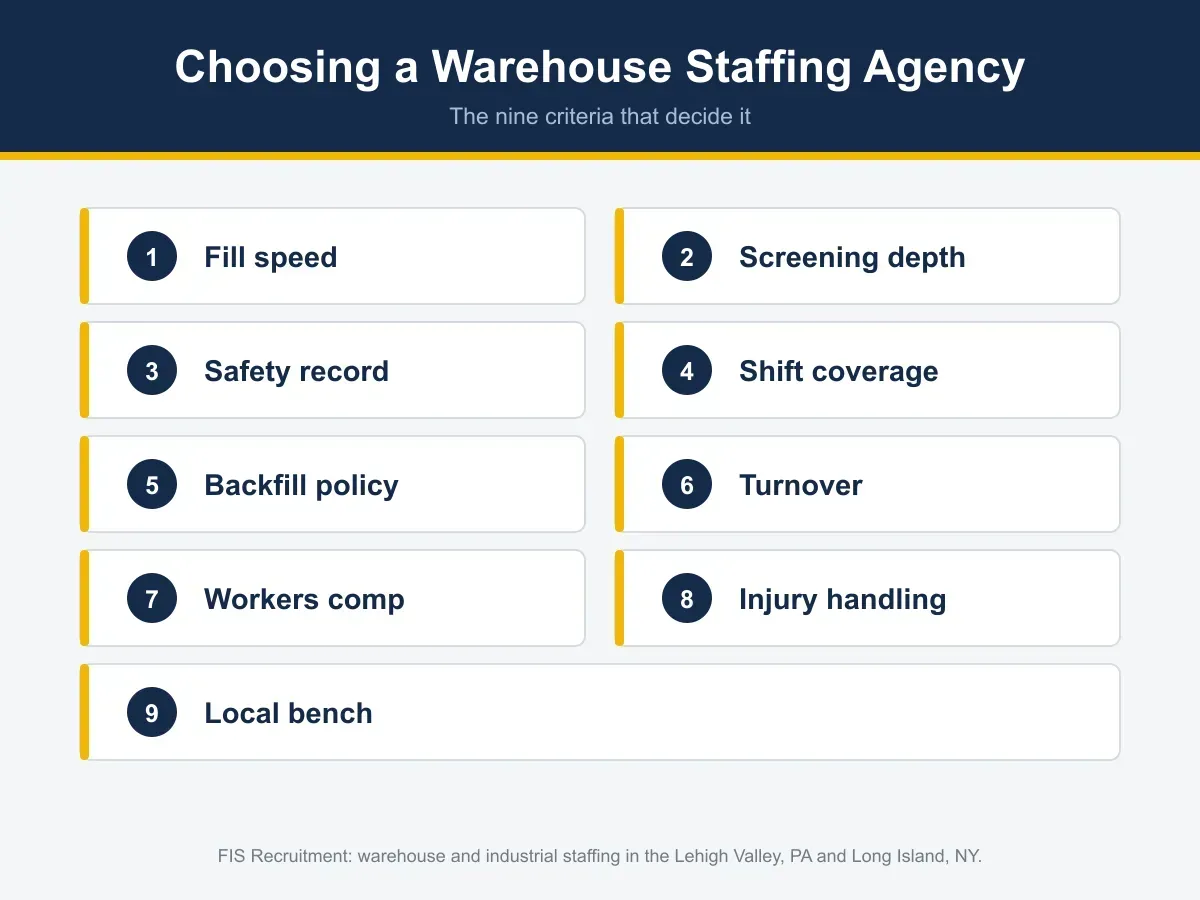
Good answer vs red flag
Use this table on the call. The middle column is what a real answer sounds like. The right column is the evasion you will actually hear, and it is written to be usable against any agency, including us.
| Criterion | What a good answer sounds like | Red flag |
|---|---|---|
| Fill speed | "Our median time to first slate on picker and packer roles was two business days last quarter, and we hit it on 8 of 10 requisitions. Here is the data." | "We can fill anything, same day, no problem." |
| Screening depth | "We verify the last two employers, check references, run background and drug screening where lawful, and require documented forklift evaluation. Here is a redacted sample record." | "Everyone is fully vetted." No detail on what vetted means. |
| Safety record | "We deliver general safety training before day one, we want to walk your floor before the first start, and we track recordables on our placed workers." | "Safety is your site, so that is on you." No interest in seeing the facility. |
| Shift coverage | "We filled 11 night shifts and 4 weekend shifts in your county in the last 90 days. Weekend coverage takes us a day longer than days." | "We cover all shifts," with no examples and no acknowledgement that nights are harder. |
| Backfill policy | "If someone no-shows, we are notified by your supervisor, we work the replacement immediately, and you are not billed for the unworked hours. It is clause 6 in the agreement." | "We will take care of you." Nothing in writing, no named response time. |
| Turnover | "On your role type our 30 day retention was around 8 in 10 last quarter. Weekend nights run lower and we will tell you why." | Quotes a national industry average instead of their own placement data. |
| Workers comp | "We are the employer of record. We carry workers compensation and unemployment, and here are current certificates of insurance." | Vague on employer of record status, or slow to produce certificates. |
| Injury handling | "Your supervisor calls us immediately, we open the claim, we join the investigation, and you get a written summary. Here is how the last one went." | "That has never happened to us." Either untrue or a sign of very little volume. |
| Local bench | "Most of the people we would send you live within 20 minutes of this facility, and we recruit in this county specifically." | "We have a database of thousands." A database is not a bench. |
The vendor evaluation questions to ask on the call
Fifteen questions, grouped, each one sentence, ready to paste into an email before a vendor call.
Speed and capacity
- What was your median time to first qualified slate on this role type last quarter?
- How many requisitions of this type did you fill in my county in the last 90 days?
- What is your realistic time to start once I approve a candidate?
Screening and safety
- Exactly what do you verify, and what do you not verify?
- How do you evidence forklift certification and evaluation?
- What safety training do you deliver before day one, and in which languages?
- Will someone from your team walk my floor before the first start?
Coverage and backfill
- What is your written no-show policy, and how fast does a replacement arrive?
- Who absorbs the cost of the unworked hours when someone does not show?
- What is your first 30 day retention on workers you have placed in roles like mine?
Money and terms
- What is my bill rate and exactly how is it calculated?
- Is there a conversion fee, and does it prorate as hours accrue?
- What is the replacement guarantee window, and what does it actually cover?
- What happens to the rate if I extend the assignment or add a shift?
Injury and liability
- When a worker is injured on my floor, who reports, who investigates, who pays, and how fast am I told?
Safety is a staffing decision, not just an EHS one
Safety belongs in the vendor conversation because responsibility is shared, not transferred. OSHA states that "staffing agencies and host employers are jointly responsible for maintaining a safe work environment for temporary workers," and describes the usual division: "staffing agencies might provide general safety and health training, and host employers provide specific training tailored to the particular workplace equipment/hazards." OSHA adds that host employers "must treat temporary workers like any other workers in terms of training and safety and health protections."
So agree in writing, before the first start, who delivers site specific orientation, who supplies PPE, who documents forklift evaluations, and who investigates an incident. If your facility is in New York, note that the New York State Department of Labor's Warehouse Worker Protection Act applies to employers with 100 or more employees at a single warehouse distribution center, or 1,000 or more across facilities in the state, and requires that any quota an employee is subject to be disclosed in writing rather than left undisclosed. New York's Department of Labor notes the quota provisions apply only to employers who actually set quotas or monitor work speed data. Confirm the specifics with your own counsel. This is context, not legal advice.
Warehouse roles worth handing to an agency
The roles that suit agency staffing are the ones with clear task definitions and volume that moves with your season: pickers, packers, forklift and reach truck operators, material handlers, dock and shipping and receiving workers, inventory and cycle count associates, sanitation, warehouse leads, and shipping office support.
As a rule, use temp for a known length peak or leave coverage, temp to hire for seats you intend to keep but need to test, and direct hire for warehouse leads, supervisors, and inventory control roles where a trial is impractical. The distinction turns on who employs the worker and for how long, which is worth understanding before you sign anything. For the local version of that comparison, see how the three models compare in the Lehigh Valley.
How we answer this checklist
Here is FIS against the same nine criteria, plainly. On fill speed, most clients see a qualified slate within 24 to 72 hours after intake for common warehouse roles. On screening, we assess commute expectations, preferred shifts, warehouse experience, safety awareness, and reliability before we present anyone. On local bench, we recruit across Allentown, Bethlehem, Easton, Hazleton, and the I-78 corridor, and on Long Island from Islandia and Hauppauge, because commute reality decides week two. On workers comp and unemployment, we are the employer of record on temp and temp-to-hire assignments and we carry the coverage. On replacement, our employers page states an employee can be replaced quickly and that FIS is responsible for unemployment claims. On injury handling, your supervisor notifies us immediately and we run the claim with you. We do not publish bill rates or markup, because both are quoted per requisition. Ask us, and you will get the numbers in writing.
More detail on the service itself is in how we staff Lehigh Valley warehouses and on our industrial staffing page. For the longer view on keeping a bench ready before you need it, see building a Lehigh Valley talent pipeline.
Metrics that tell you the agency is working
Six numbers, reviewed monthly, will tell you whether the vendor relationship is working: time to first slate, time to start, fill rate, first shift show rate, first 30 day retention, and recordable incidents on agency workers. First shift show rate is the one most employers forget to track and the one that predicts the rest, because a worker who shows up on day one has usually been screened for the commute and the shift, not just the skill.
Frequently asked questions
How do I choose a warehouse staffing agency?
Compare agencies on nine things: fill speed, screening depth, safety record, shift coverage, backfill policy, turnover on their own placements, workers compensation and employer of record status, injury handling, and whether they have a genuine local bench. Ask for evidence on each rather than assurances, and get the no-show policy and the fee terms in writing before you sign. An agency that measures itself can answer all nine in a single call. One that cannot is asking you to take its word.
How fast should a warehouse staffing agency fill a shift?
Ask for the median, not the best case, because the median is what you will actually experience. For common warehouse roles like picker, packer, and material handler, a slate of qualified candidates within a few business days of a clear intake is a reasonable expectation, and FIS states most clients see a qualified slate within 24 to 72 hours after intake. Nights, weekends, and certified forklift roles legitimately take longer. Any agency promising same day fills on every role is describing a sales position, not a process.
Who is responsible if a temp worker is injured in my warehouse?
Both parties, in different ways. OSHA states that staffing agencies and host employers are jointly responsible for maintaining a safe work environment for temporary workers, with the agency typically providing general safety training and the host employer providing training specific to the workplace equipment and hazards. OSHA also says host employers must treat temporary workers like any other workers for training and safety protections. Agree in writing who reports, who investigates, and who supplies PPE before the first start, and confirm the specifics with your own counsel.
Does the staffing agency or my company carry workers comp for temp workers?
The staffing agency normally carries it, because on temp and temp-to-hire assignments the agency is the employer of record. Ask for a current certificate of insurance rather than assuming. The The Pennsylvania Department of Labor and Industry states that workers compensation coverage is mandatory for most employers under Pennsylvania law, and that employers without it may be subject to lawsuits by employees and to criminal prosecution. The New York State Workers' Compensation Board states New York employers may be required to carry workers compensation, disability benefits, and Paid Family Leave coverage.
What should a warehouse staffing agency screen for?
At minimum: verified work history, references, background and drug screening where lawful, documented evidence of forklift certification and evaluation for equipment roles, and comprehension of safety instructions in the language the worker actually uses. Beyond that, the screening that predicts retention is practical rather than technical: realistic commute, the shift the person genuinely wants, and whether they have done this kind of physical work before. Ask any agency for a redacted sample screening record. A serious one will send it.
What is a reasonable no-show and backfill policy?
A reasonable policy is written, names a response time, and says who absorbs the cost of the unworked hours. It should cover who your supervisor calls, how quickly the agency starts working a replacement, whether the replacement arrives the same shift or the next one, and what happens on nights and weekends when the agency office is closed. Verbal reassurance is not a policy. If it is not a clause in the agreement, treat it as marketing rather than a commitment.
How much does a warehouse staffing agency cost?
You pay an hourly bill rate that covers the worker's wage plus the employment costs the agency carries and its service fee, which is why the bill rate is always above the wage. There is no reliable published industry rate for warehouse markup, and rates are not comparable across markets: New York's Long Island minimum wage is $17.00 per hour as of January 2026, while Pennsylvania's remains $7.25. Ask any agency to break the rate into its components and to state the conversion fee terms in writing.
Talk through your shift coverage with us
If you are running this checklist across vendors, run it on us too. We will give you the median, not the best week.
Open a requisition, call
800.248.8687, or email
info@fisrecruitment.com to walk through a coverage plan for your facility across the Lehigh Valley and Long Island.