
Temp to Hire: What It Means for Employers (2026)
By the FIS Recruitment staffing team | Last updated: August 2026
Quick take. Temp to hire means a staffing agency recruits and employs the worker, places them at your site under your day to day direction, keeps them on the agency payroll through an agreed evaluation period, and moves them to your payroll only if both sides want the permanent relationship. That is the whole temp to hire meaning in one sentence. The employer decision is simple: temp for a known length surge, temp to hire when fit is the open question, direct hire when the seat is permanent, senior, or confidential. At FIS Recruitment, most clients see a qualified slate within 24 to 72 hours of intake, and we run the same model across the Lehigh Valley and Long Island. Call 800.248.8687 to talk through an opening.
Temp to hire meaning, defined for employers
Temp to hire means the worker is sourced and employed by the staffing agency, works at your site on your direction, stays on the agency payroll through an agreed evaluation period, and converts to your payroll if both sides want it. The American Staffing Association defines temporary to hire as an arrangement in which "a staffing agency employee works for a client during a trial period during which both the employee and the client consider establishing a permanent employment relationship," and confirms the staffing firm employs the worker during that trial.
In practice: the agency recruits, screens, and hires the person. You supervise the work and approve the hours. The agency processes the timecard, issues the paycheck, remits payroll taxes, and issues the W-2. On conversion day the person resigns from the agency, joins your payroll, and starts your benefits enrollment and review cycle. You will see the same arrangement called contract to hire or temp to perm. Those are synonyms, so read the agreement rather than the label.
Why employers use it, and what it actually buys you
Temp to hire buys you a working trial. You watch attendance, output, safety habits, and team fit in the real job before you commit permanently. The American Staffing Association frames it the same way: the trial period is when both the employee and the client consider establishing a permanent employment relationship.
The second benefit is speed, because the agency has already carried the sourcing, screening, and payroll setup. The channel is large: the American Staffing Association reports that about 2.4 million temporary and contract employees work for United States staffing companies during an average week in 2024. What it does not buy you is a free option. You pay a bill rate above the wage while the trial runs, and a fee mechanic usually attaches to conversion.
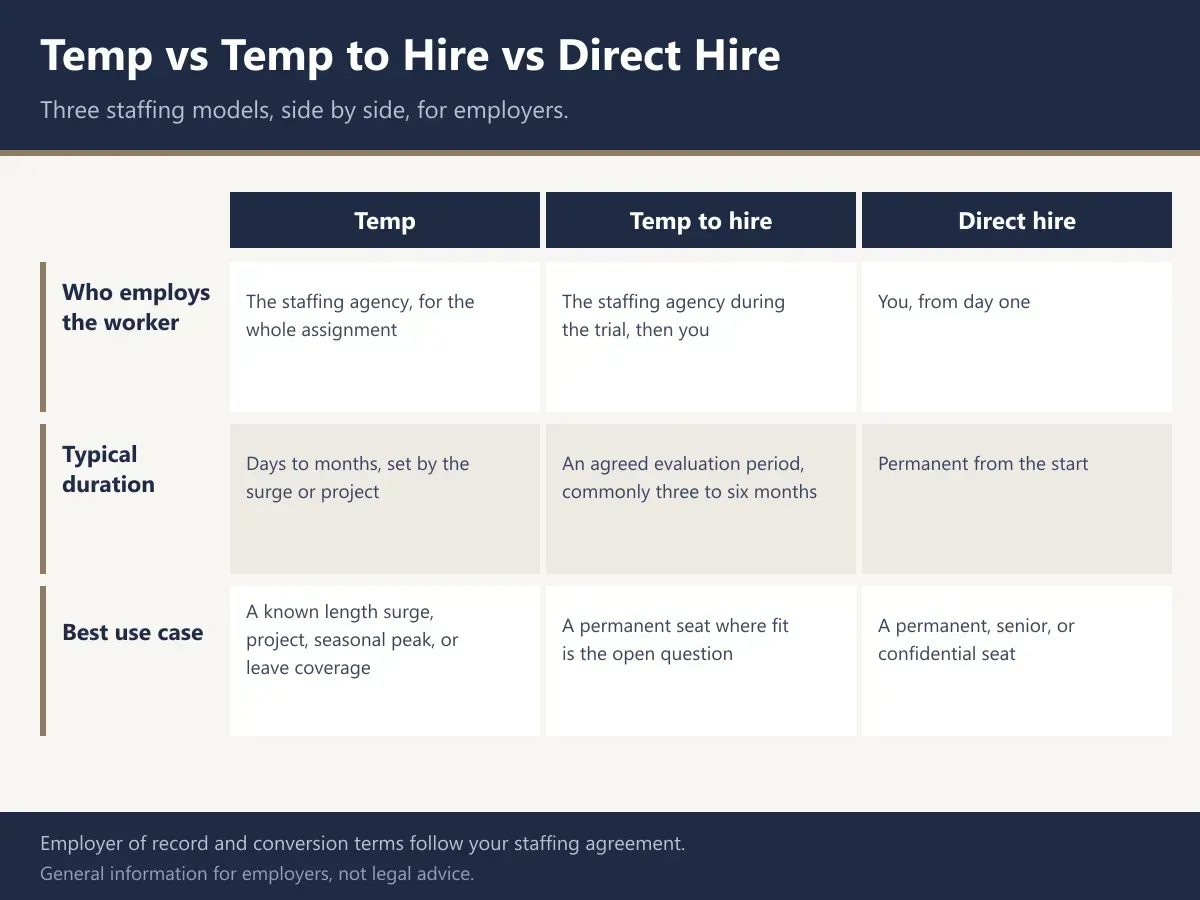
Temp vs temp to hire vs direct hire
The three models differ on one axis that decides everything else: who is the employer, and for how long. Place your opening on the table, then read the guidance under it.
| Question | Temp | Temp to Hire | Direct Hire |
|---|---|---|---|
| Who employs the worker | the staffing agency, for the whole assignment | the staffing agency during the trial, then you | you, from day one |
| Who runs payroll, taxes, and workers comp | the agency | the agency until conversion, then you | you |
| Who carries the unemployment and liability exposure | the agency is the legal employer and carries wages, payroll taxes, unemployment, and workers comp; you keep primary responsibility for a safe worksite | same as temp until conversion, then the full exposure moves to you | you, from day one |
| Typical duration | days to months, set by the surge or project | an agreed evaluation period, commonly three to six months | permanent from the start |
| How the worker becomes yours | they do not, unless you renegotiate | you convert them during or at the end of the evaluation period | they already are |
| What you pay and when | an hourly bill rate for every hour worked, invoiced as you go | the bill rate during the trial, plus any conversion fee at hire | a placement fee, normally after the person starts |
| Best use case | a known length surge, project, seasonal peak, or leave coverage | a permanent seat where fit is the open question | a permanent, senior, or confidential seat |
| Biggest risk | you build no permanent capacity and pay a bill rate throughout | a long trial on a stable role can cost more than a placement fee | you carry the full cost of a bad hire yourself |
Read it against your actual opening, not your preference. Defined end date and no headcount to convert into: use straight temp. Permanent seat where the only real unknown is this person: temp to hire is doing work for you. Permanent seat where the risk is seniority, confidentiality, or a long ramp: direct hire, even though it costs more up front. One last test. If you would not convert this person under any circumstances, do not open a temp to hire requisition.
How long the evaluation period runs
There is no single legal or industry standard length. Indeed's career guide says most temp to hire periods "last from three to six months," and the agreement always governs. FIS measures the same commitment in hours: our live Lehigh Valley staffing guide and our employers page both reference a minimum of 700 hours before conversion, roughly four months on a standard full time schedule.
Hours are the fairer unit because they do not penalize a variable schedule. What actually sets the length is role complexity, ramp time, and your client agreement. A pick and pack role shows you everything in a few weeks. A machine operator or a customer service lead with a systems learning curve needs longer before the trial tells you anything real.
Conversion fees, explained without the runaround
Agencies recover the recruiting investment two ways: through the hourly markup over time, or through a conversion fee when you hire the person. The American Staffing Association states the mechanic plainly on its client FAQ, noting that many staffing firms let you hire a temporary or contract employee permanently and that "a placement fee may be negotiated with a staffing firm to complete the hiring process." Note the words may be. There is no published industry rate card, and any single percentage quoted online is one firm's practice, not a standard, so this post gives you the model instead of a number.
A conversion fee has four components, and they are the four questions to ask any agency before you sign:
- Is there a fee at all? Some agreements have none once an hours threshold is met.
- How is it calculated? A percentage of first year salary and a flat dollar amount behave very differently across your pay bands.
- Does it prorate as hours accrue? Many agreements reduce the fee as the worker logs hours, because the markup has already repaid part of the recruiting cost.
- At what point does it reach zero? Get the hour count or the date in writing. That number changes your math.
FIS quotes per requisition rather than from a rate card, so we do not publish our own numbers here. Ask us those four questions and you will get the answers in writing before you commit.
Co-employment, in plain terms
Co-employment is the relationship in which two employers each hold legal rights and obligations toward the same worker, which is exactly what a staffing assignment creates. The American Staffing Association defines it as "the relationship between two employers, such as a staffing firm and its client, in which each has legal rights and obligations with respect to the same employees," and describes the normal split: the staffing firm recruits and screens, employs the worker and pays wages, remits payroll taxes including unemployment insurance, provides workers compensation coverage, and holds the right to hire, fire, and reassign, while the client supervises and directs the work at the worksite.
Your practical rules are short. Route discipline and termination decisions through the agency. Keep assignment workers off your benefits plans and out of your internal review cycle until they convert. Document safety training and site specific hazard briefings, because primary responsibility for a safe worksite sits with you. This is a plain English summary, not legal advice. Confirm anything that carries risk with your own counsel.
When temp to hire is the wrong choice
- A senior, confidential, or leadership seat. A working trial is not realistic when the role carries budget authority, personnel decisions, or confidential information, and strong candidates will not leave a permanent job for a trial. Go direct hire.
- A genuinely fixed length surge. If the work ends in November and you have no headcount to convert into, use straight temp.
- A role needing a license, a clearance, or a long certification runway. If the person cannot yet perform the full job, the trial measures nothing useful.
- A stable, long horizon role. Months of hourly markup can exceed a one time placement fee. No reliable published percentage marks the crossover, so run it on your own numbers: quoted bill rate minus the wage you would pay directly, multiplied by the hours you expect before conversion, compared against the direct hire fee you were quoted.
How we run temp to hire, step by step
Conversion intent is stated at intake, not discovered later.
- Day 0 to 1, intake. Title, duties, shift, pay range, must have traits, physical demands, and whether you intend to convert.
- Day 1 to 2, sourcing. The local Lehigh Valley and Long Island bench first, because commute reality predicts whether someone stays.
- Day 1 to 3, structured screening. Same questions, same order, every candidate, so the shortlist is comparable.
- Day 2 to 4, shortlist. Three to seven candidates, with the tradeoffs named rather than hidden.
- Week 1, start and day one readiness. PPE, systems access, badge, and the name of the person meeting them at the door.
- Day 30, check in. With you and with the worker, separately.
- The conversion conversation, on the hours or the date agreed at intake.
See our employer services and process, or read how the three models compare in the Lehigh Valley.
Metrics that tell you it is working
Six numbers tell you whether a temp to hire program works, and only one is about speed: time to first slate, time to start, fill rate, first 30 day retention, conversion rate of your temp to hire assignments, and cost per converted hire. Conversion rate matters most, because it proves the screening works. If most assignments never convert, either the screening is missing something or the requisitions were never permanent seats.
Before you open a temp to hire requisition, a manager checklist
- Is conversion genuinely intended, or is this a temp assignment wearing a different label?
- What does the permanent version of this role pay, and is that defensible against the local market?
- What is the shift, and what is the commute from where your candidates actually live?
- What does day one readiness require: PPE, systems access, badge, safety orientation, a named greeter?
- Who owns the 30 day check in, by name?
- What does your agreement say about conversion fees, proration, and the replacement guarantee?
For office and clerical seats, our guides to office staffing in Bethlehem and choosing a staffing agency in Bethlehem go deeper on intake.
Local context matters here. The Bureau of Labor Statistics put the Allentown, Bethlehem, Easton PA-NJ metro unemployment rate at 4.1 percent in June 2026, preliminary, against a labor force of about 469,200. On Long Island, BLS put the Nassau County-Suffolk County metro division at 3.5 percent in the same month, also preliminary. Neither market is loose, which argues for keeping a screened bench available rather than starting from zero each time a seat opens.
Frequently asked questions
What does temp to hire mean for an employer?
Temp to hire means a staffing agency employs the worker while they do your job at your site, and you convert them to your own payroll only if the trial goes well. You direct the day to day work and approve the hours. The agency handles recruiting, payroll, payroll taxes, workers compensation, and unemployment during the assignment. The American Staffing Association describes it as a trial period during which both the employee and the client consider establishing a permanent employment relationship.
How long does a temp to hire period usually last?
Most temp to hire periods run three to six months, according to Indeed's career guide, though the agreement always governs. FIS measures the same commitment in hours and references a minimum of 700 hours before conversion, roughly four months on a standard full time schedule. Hours are the fairer unit because they do not penalize part time or variable schedules. Role complexity, ramp time, and your client agreement set the real length, so agree the number before the person starts.
Do you pay a fee to convert a temp employee to a permanent hire?
Usually yes, and the amount is negotiated rather than fixed by any industry rate card. The American Staffing Association notes that many staffing firms let clients hire a temporary or contract employee permanently and that a placement fee is negotiated to complete the hiring process. Many agreements prorate that fee down as the worker logs hours, and some reach zero at an agreed threshold. Ask whether a fee applies, how it is calculated, whether it prorates, and when it reaches zero.
Who is the legal employer during a temp to hire assignment?
The staffing agency is the legal employer of the worker during the assignment, and you are the party directing the work. The American Staffing Association describes the standard split: the staffing firm recruits and screens, pays wages, remits payroll taxes including unemployment insurance, provides workers compensation coverage, and holds the right to hire, fire, and reassign, while the client supervises and directs activities at the worksite. That shared arrangement is called co-employment. This is a plain summary and not legal advice.
Is temp to hire cheaper than direct hire?
It depends on how long the trial runs, and you can calculate the crossover yourself. During the assignment you pay an hourly bill rate above the wage, so a long trial on a stable role can total more than a one time placement fee. Take the quoted bill rate, subtract the wage you would pay directly, multiply that gap by the hours you expect before conversion, then compare against the direct hire fee you were quoted. Temp to hire wins when fit is genuinely uncertain.
Can you end a temp to hire assignment early?
Yes, and that flexibility is a large part of why employers use the model. Because the agency is the legal employer of the worker, you end the assignment by notifying the agency rather than running a termination yourself, and the agency handles the employment side including any unemployment claim. FIS states on its employers page that an employee can be replaced quickly and that FIS is responsible for unemployment claims. Check your agreement for notice terms and for what the replacement guarantee covers.
When should an employer choose direct hire instead of temp to hire?
Choose direct hire when the seat is permanent, senior, or confidential, or when a working trial is not realistic. Roles with budget authority, personnel decisions, or access to confidential information do not suit a trial, and strong candidates for them will not leave a permanent job to take one. Direct hire also fits roles requiring a license, a clearance, or a long certification runway, and stable long horizon roles where months of hourly markup would exceed a placement fee.
Talk through the right model for your next opening
If you are weighing temp, temp to hire, and direct hire for a specific seat, we will tell you which one fits, including when the answer is not the one we bill the most for. Open a requisition, call 800.248.8687, or email info@fisrecruitment.com. We staff industrial, office and clerical, and sales and customer service roles across the Lehigh Valley in Allentown, Bethlehem, Easton, and Hazleton, and across Long Island from Islandia and Hauppauge.